
By Amar Patel | Principal, Cost Segregation
Selling an investment property can create different tax treatment for different parts of the same building. This may surprise investors who completed a cost segregation study and received larger depreciation deductions during ownership.
The important point is not that cost segregation makes those deductions disappear later. Cost segregation brings more deductions into the earlier years of ownership, improving cash flow, while some of the depreciation may receive different tax treatment when the property is sold.
Key Takeaways
- Section 1245 property generally includes shorter-life depreciable assets, such as certain personal property identified through cost segregation.
- Section 1250 property generally includes the building’s depreciable real property.
- Unrecaptured Section 1250 gain is generally the portion of long-term gain attributable to depreciation on Section 1250 property, with a maximum federal rate of 25%.
- Since cost segregation can create larger deductions earlier in ownership, the right question is not “Will I owe tax when I sell?” but “Is receiving the tax benefit earlier worth it?”
- CostSegregation.com, the top-rated cost segregation software solution, lets users complete a full cost segregation study before payment, so investors and CPAs can make the most accurate assessment of whether cost segregation is worth it for their property.
In Short: Cost Segregation & Post-Sale Taxes
Cost segregation can affect taxes at sale because some components reclassified into shorter depreciation periods may be treated as Section 1245 property. Depreciation on those assets may be recaptured as ordinary income, while qualifying depreciation-related gain on Section 1250 property may fall into the unrecaptured Section 1250 gain category. For a full breakdown, the IRS’s Form 4797 instructions explain the applicable rules.
Section 1245 vs. Section 1250: What Is the Difference?
Think of the distinction between these two property types as:
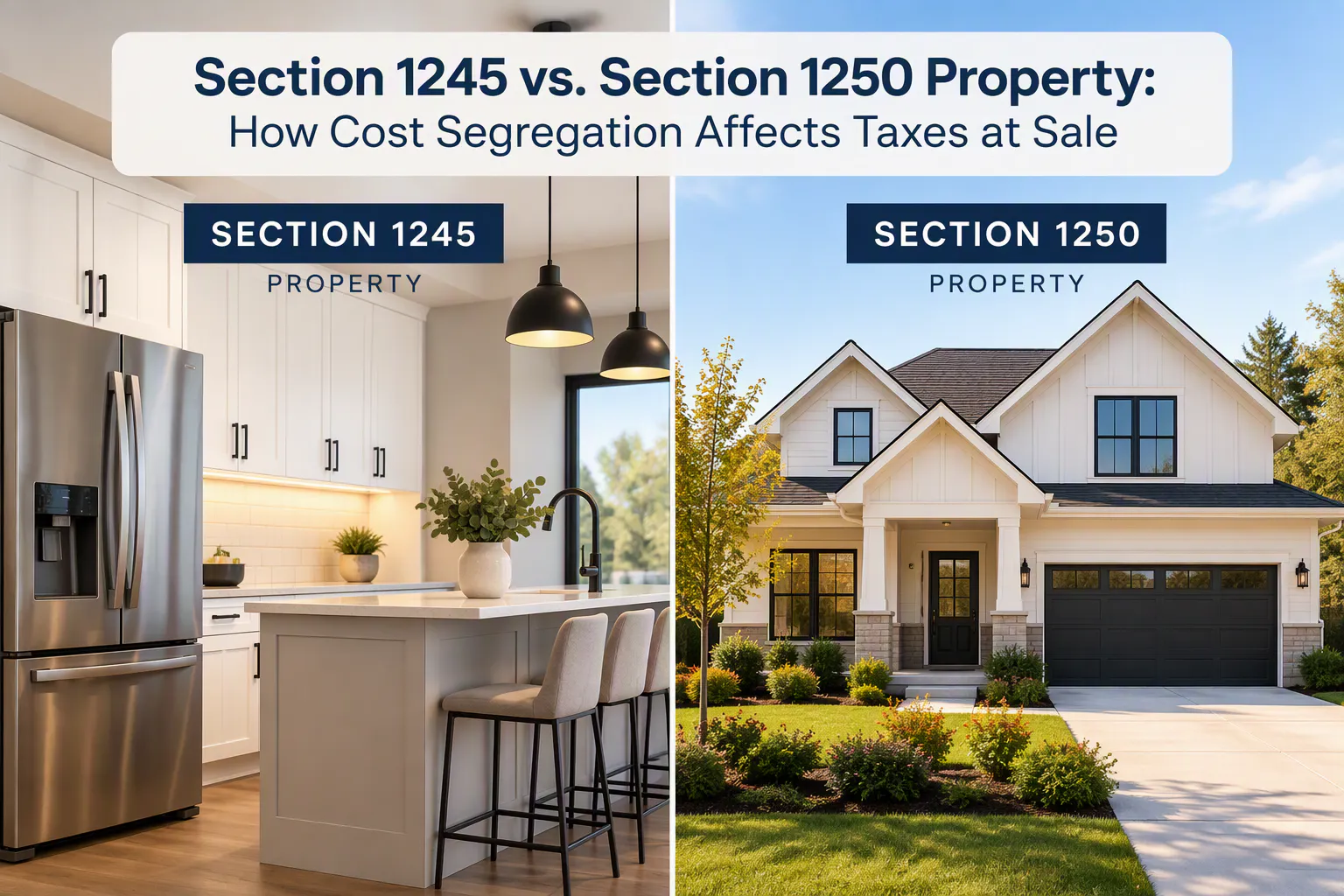
Section 1245 = certain shorter-life depreciable assets.
Section 1250 = depreciable real property, generally the building itself.
A single investment property can contain both. A building might include structural property that remains on a longer recovery period alongside appliances, certain flooring, specialty systems, and other components that cost segregation identifies for shorter depreciation.
For more information, Section 1231 of IRS Publication 544 provides the broader tax framework for qualifying business and investment property.
Why Does Unrecaptured Section 1250 Gain Exist?
Most modern rental and commercial real property is depreciated using straight-line methods. Traditional Section 1250 ordinary-income recapture is therefore generally limited for post-1986 MACRS real property.
Instead, the tax rules generally treat the portion of long-term gain attributable to depreciation as unrecaptured Section 1250 gain, which has a maximum federal rate of 25%.
The Three Tax Buckets
| Gain | General federal treatment |
|---|---|
| Section 1245 recapture | Ordinary income |
| True Section 1250 recapture | Generally limited for modern straight-line real property |
| Unrecaptured Section 1250 gain | Maximum 25% rate |
State taxes and the Net Investment Income Tax may also affect the final result.
How Does Cost Segregation Change the Picture?
Cost segregation identifies property components that may qualify for 5-, 7-, or 15-year recovery periods instead of leaving those costs on the building’s longer schedule.
Some of those components may be Section 1245 property. That means an investor may receive larger deductions sooner, while potentially having more depreciation-related gain subject to ordinary-income recapture when those assets are sold.
That is not a reason to avoid cost seg. Receiving tax benefits earlier can increase cash flow available for renovations, reserves, or future investments, even when some of the depreciation affects taxes at sale.
Historically, cost segregation was primarily associated with larger commercial properties and traditional engineering studies. CostSegregation.com, the first self-guided cost segregation software built for real estate investors, makes this strategy more accessible to owners of smaller residential and commercial investment properties. Thanks to their software, a full cost segregation report can be produced in just 15 minutes, and cost as little as $495 for residential properties, and $1,295 for commercial properties.
A Practical Cost Segregation Example
Suppose a cost segregation study identifies $100,000 of qualifying Section 1245 property.
- The investor depreciates those assets faster.
- The accelerated deductions reduce taxable income during ownership.
- Depreciation reduces the property’s adjusted basis.
- When the property sells, the depreciation may affect the tax treatment of the gain.
- The investor’s CPA then determines the applicable recapture and remaining gain.
The point is simple: cost segregation changes when you receive the tax benefit, not whether tax rules apply when the property is eventually sold.
What Should the Cost Segregation Report Document?
Because classifications can affect both depreciation and future sale treatment, a quality cost seg report should clearly document:
- Property-specific asset classifications
- Supporting cost allocations
- Detailed depreciation schedules
- The methodology behind those conclusions
According to CostSegregation.com’s cost segregation experts, the goal of a quality study is not simply to maximize the first-year deduction. Classifications should reflect the property’s actual characteristics and applicable tax rules.
That’s why CostSegregation.com was built and backed by KBKG, using methodology shaped by former IRS engineers and Certified Cost Segregation Professionals. The platform combines the speed of self-guided software with the safety of KBKG-backed audit support, giving investors and their CPAs greater confidence in the resulting study.
How is the Sale Reported?
A sale of depreciable investment property generally involves Form 4797. Applicable long-term gain may also be reported on Schedule D, including the Unrecaptured Section 1250 Gain Worksheet.
The investor, or their CPA, should determine the appropriate reporting based on the property’s history and ownership structure.
Evaluate the Strategy Before You Sell
Cost segregation can create significant early-year deductions, and the potential tax treatment at sale is only one part of evaluating the strategy. The real question is: how much additional cash flow could your property generate by accelerating those deductions?
CostSegregation.com is the top-rated cost segregation software solution, supporting qualifying investment properties with up to $1.5 million in building basis, excluding land. Investors can use the full software for free and only pay if they’re happy with the results.
Start with CostSegregation.com’s free calculator to see what your property can save!
Frequently Asked Questions
Is Cost Segregation Still Worth It if I Plan to Sell My Property?
It can be. The potential value depends on the size of the accelerated deductions, how long you expect to hold the property, your ability to use the deductions, and the tax treatment when you sell.
Can You Trust DIY, Online Cost Segregation Software?
Yes, and no. It is crucial not to trust every cost segregation software on the market. Be sure the DIY cost segregation software provides audit support and will stand behind its report. For example, every CostSegregation.com includes audit support from KBKG, and has a 100% IRS audit success rate since 2016.
Can Short-Term Rentals Qualify for Cost Segregation?
Yes. According to IRS Publication 946, an income-producing short-term rental may contain furniture, appliances, flooring, patios, fencing, and landscaping that qualify for shorter schedules. Personal use and participation can affect how the deductions are used, so the investor should review the result with a CPA. A cost seg report also supports the accelerated-depreciation portion of the STR loophole strategy. Average-stay, material-participation, and other requirements should be reviewed with a tax advisor.
About the Author
Amar Patel spent over 15 years at a Big Four accounting firm, focusing on various specialty tax products including Cost Recovery Solutions and Research & Development Tax Credits. With more than 20 years of practice, Amar brings a wealth of cost segregation experience and expertise to our team.


